AI policy for schools
An AI policy your school can adopt, aligned to the national framework.
Get the template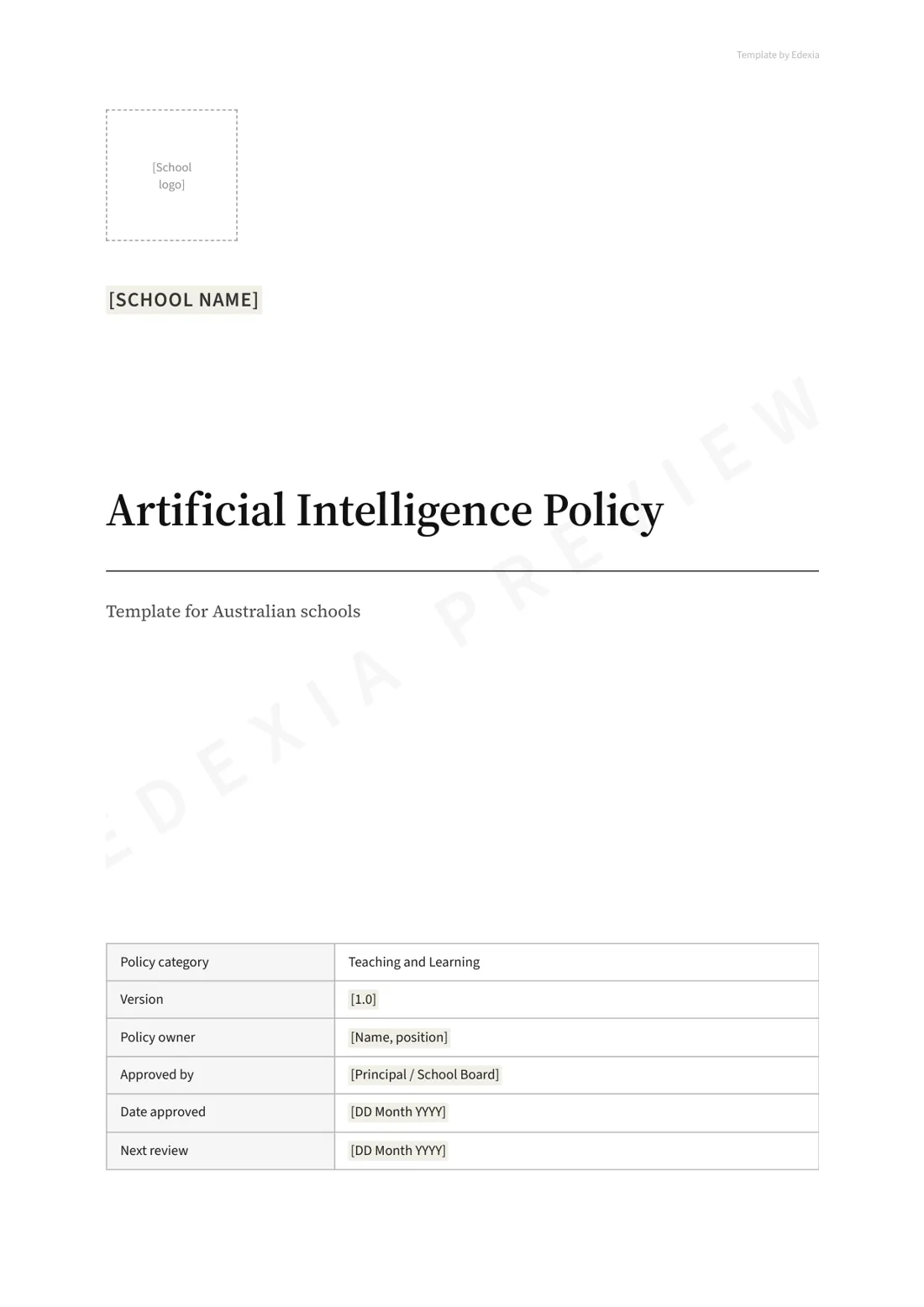
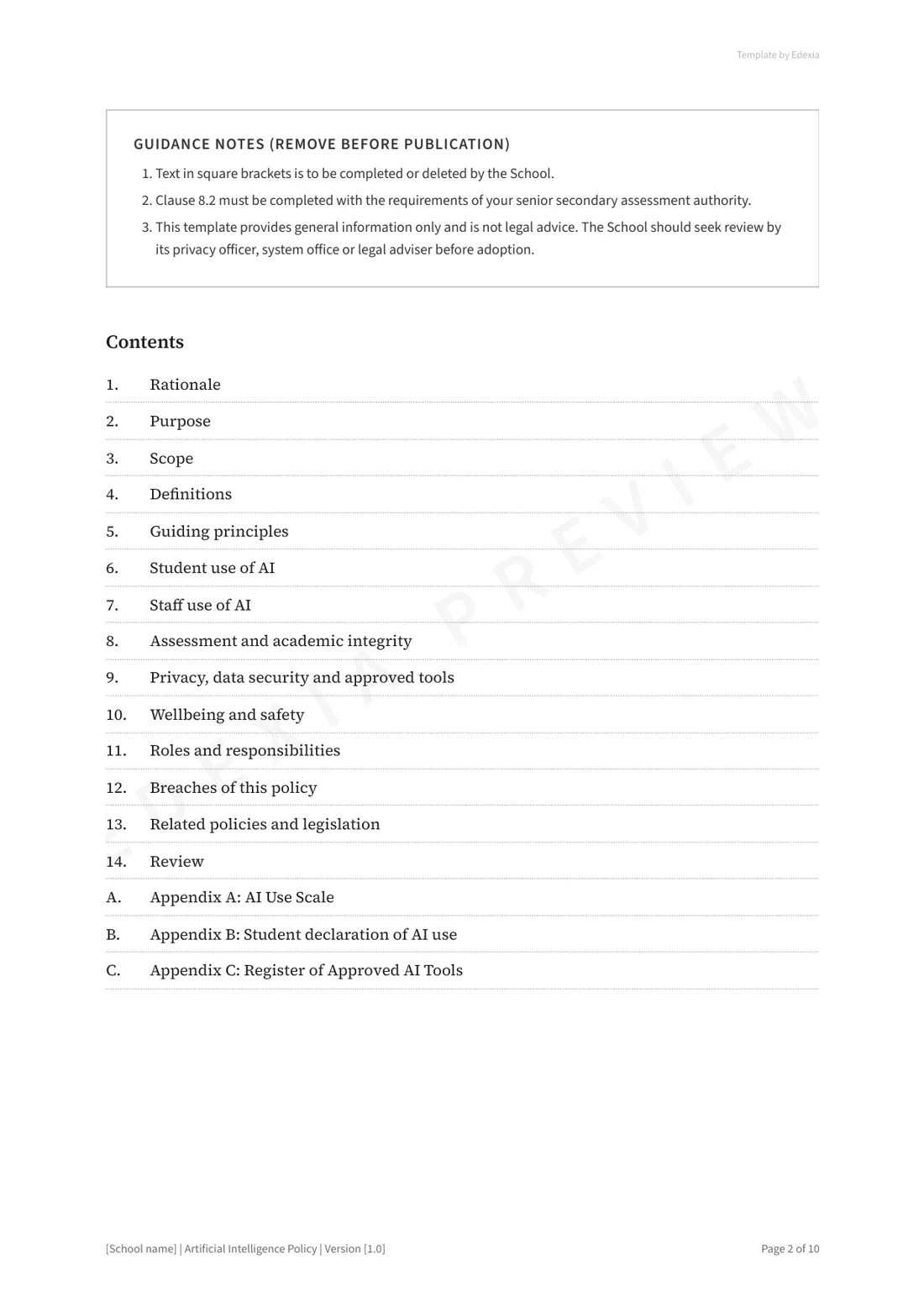
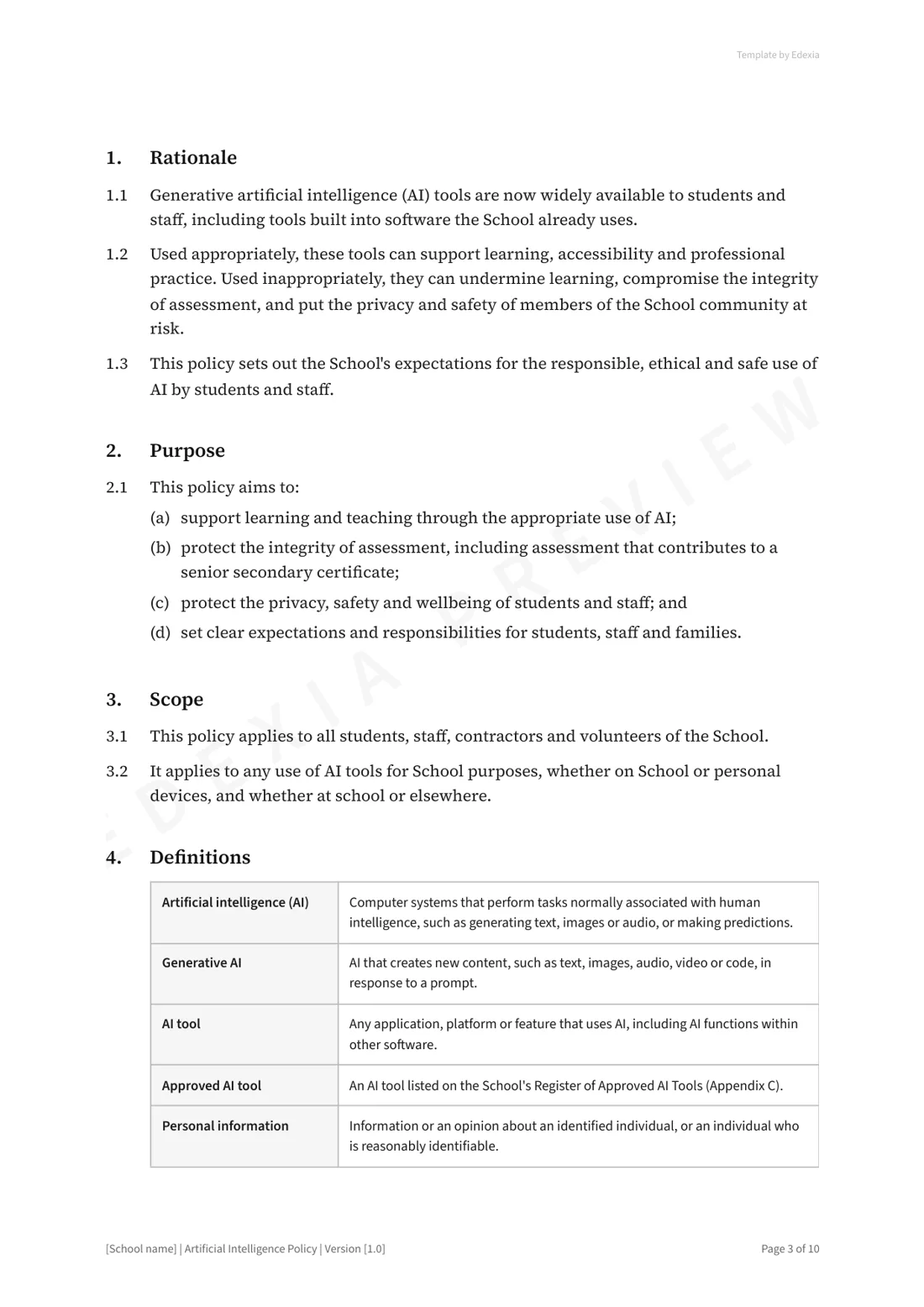
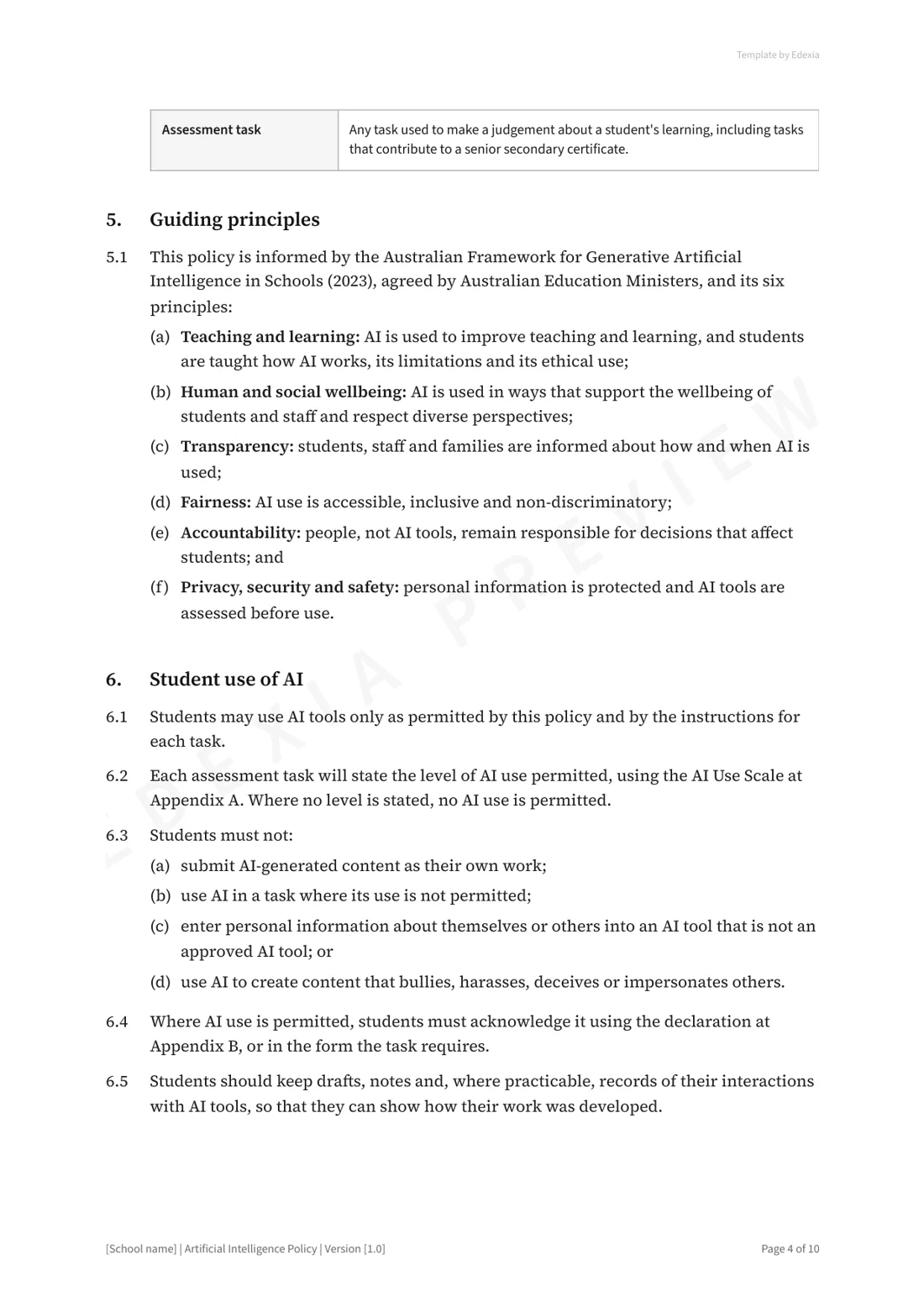
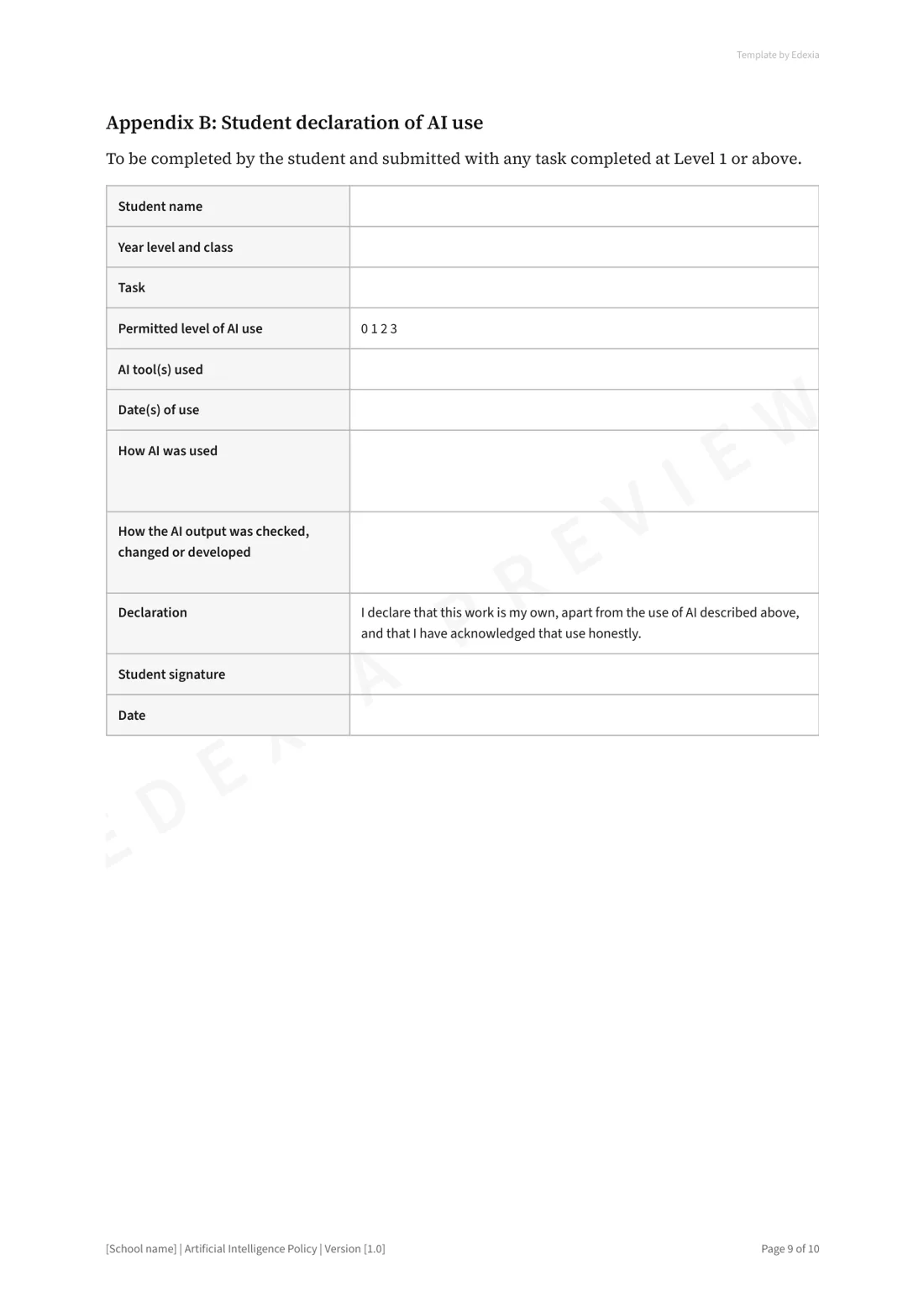
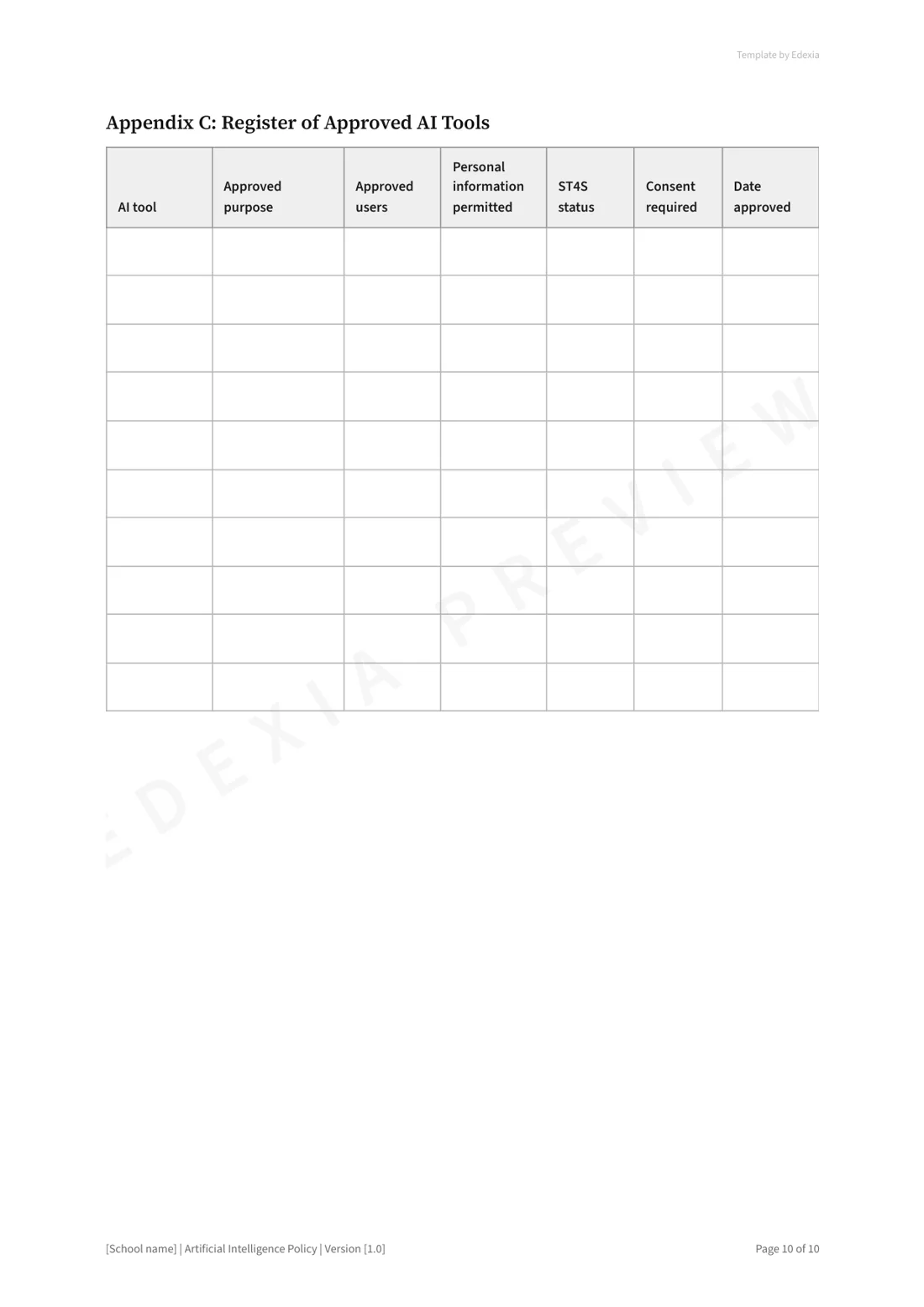
Get the template for your school
We'll email you the full policy as an editable Word document and a PDF, without the watermark.
Learn how other schools are approaching AI policyTrusted by 50+ schools around Australia






A version for your certificate
- VCEVictoria. VCAA rules and the Victorian department's AI policy.
- HSCNew South Wales. NESA rules and the NSW department's guidelines.
- QCEQueensland. QCAA rules and the Queensland department's position.
- WACEWestern Australia. SCSA's requirements for school assessment policies.
- SACESouth Australia. SACE Board rules and the SA department's guidance.
- TASCTasmania. TASC's academic integrity rules and DECYP's approach.
- BSSSACT. BSSS academic integrity rules and the ACT Education Directorate's approach.
- NTCETNorthern Territory. SACE Board rules and the NT department's policy.
- IB DiplomaIB World Schools. The IB's academic integrity rules on AI.
- APUnited States. College Board's rules on AI in AP coursework.
Built on the national framework
Education Ministers agreed the Australian Framework for Generative Artificial Intelligence in Schools in October 2023, and states and sectors have implemented it since 2024. The template follows its six principles.
- Principle 1
Teaching and learning
AI improves learning, students learn how it works and where it fails, and each task says how AI may be used.
- Principle 2
Human and social wellbeing
AI use supports wellbeing and respects diverse perspectives.
- Principle 3
Transparency
Students and families know when and how AI is used.
- Principle 4
Fairness
AI use is accessible, inclusive and fair for regional, rural and remote students.
- Principle 5
Accountability
People, not tools, make decisions about students.
- Principle 6
Privacy, security and safety
Personal information stays out of unapproved tools, and tools are checked before use.
An AI level for every task
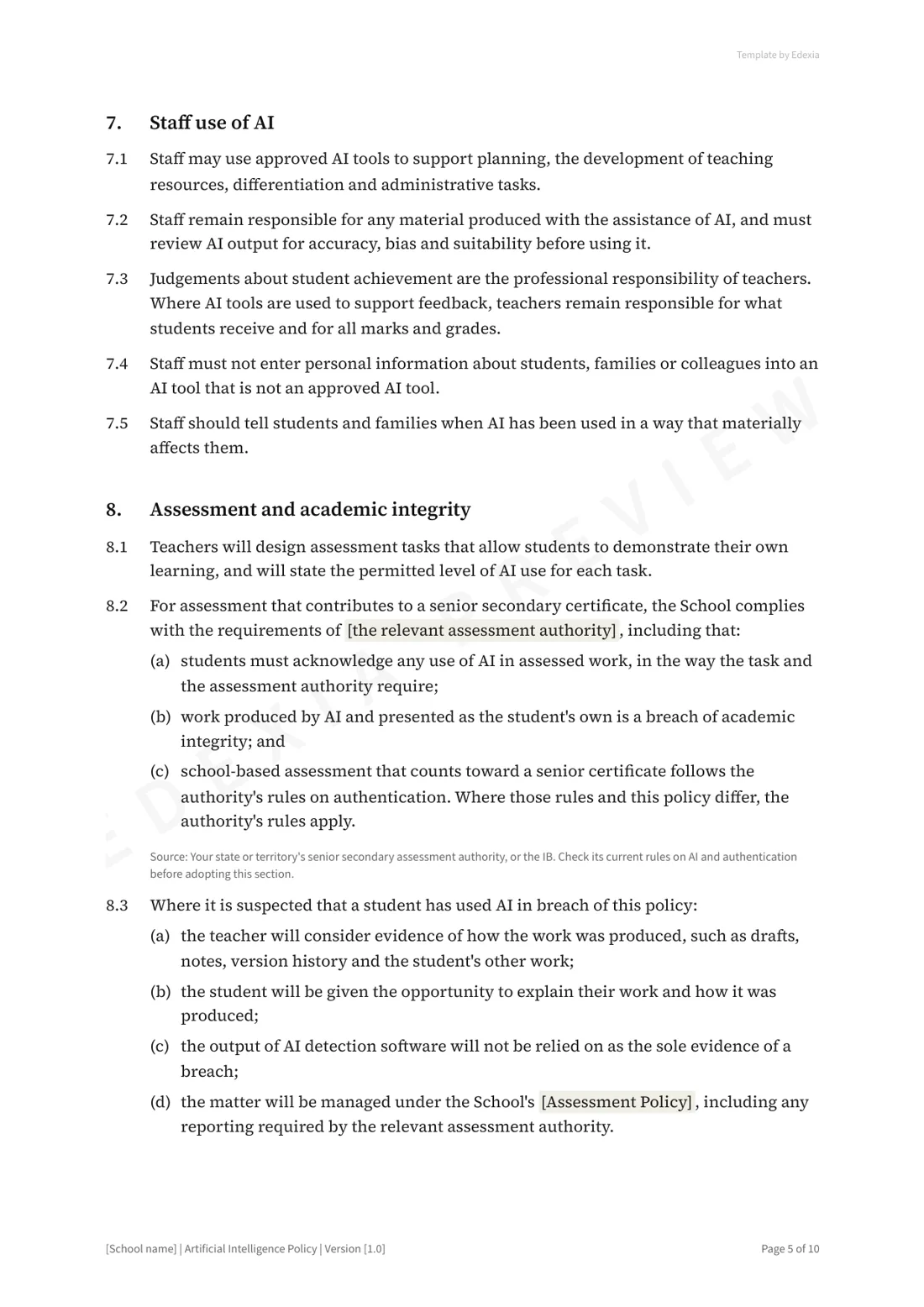
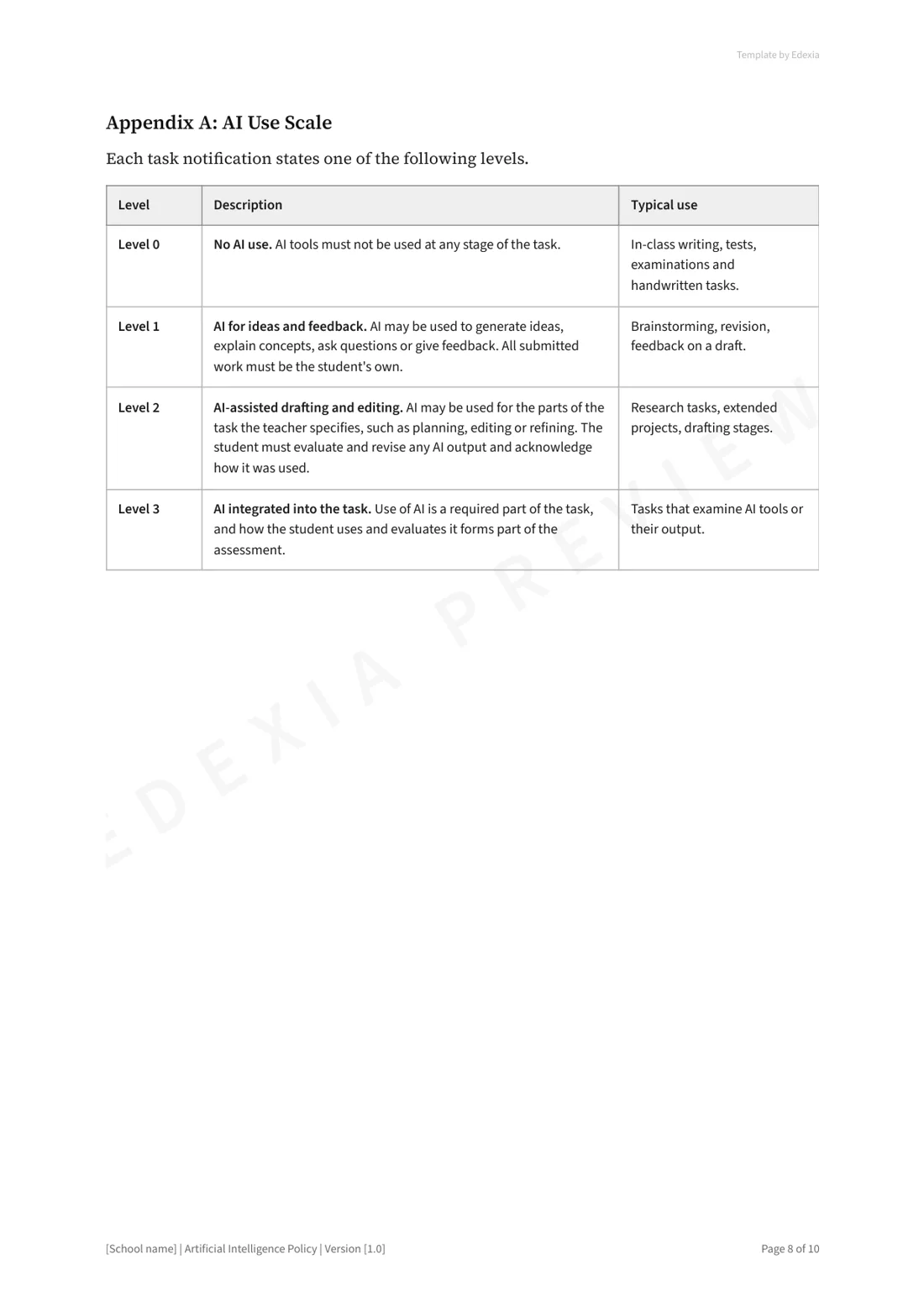
Whether AI is allowed depends on the task, so every task sheet states one of four levels. Where no level is stated, no AI use is permitted.
- Level 0
No AI use
AI tools must not be used at any stage. Typical for in-class writing, tests, exams and handwritten work.
- Level 1
AI for ideas and feedback
AI may be used to generate ideas, explain concepts, ask questions or give feedback. All submitted work is the student's own.
- Level 2
AI-assisted drafting and editing
AI may be used for the parts of the task the teacher specifies, such as planning or editing. The student revises any AI output and acknowledges how it was used.
- Level 3
AI integrated into the task
Using AI is a required part of the task, and how the student uses and evaluates it is assessed.
Staff use of AI
Staff may use approved tools for planning, resources and administration, and remain responsible for anything produced with them. Marks and grades stay the teacher's professional judgement. In Victorian government schools, staff must not use generative AI to judge student achievement or write reports.
Privacy and approved tools
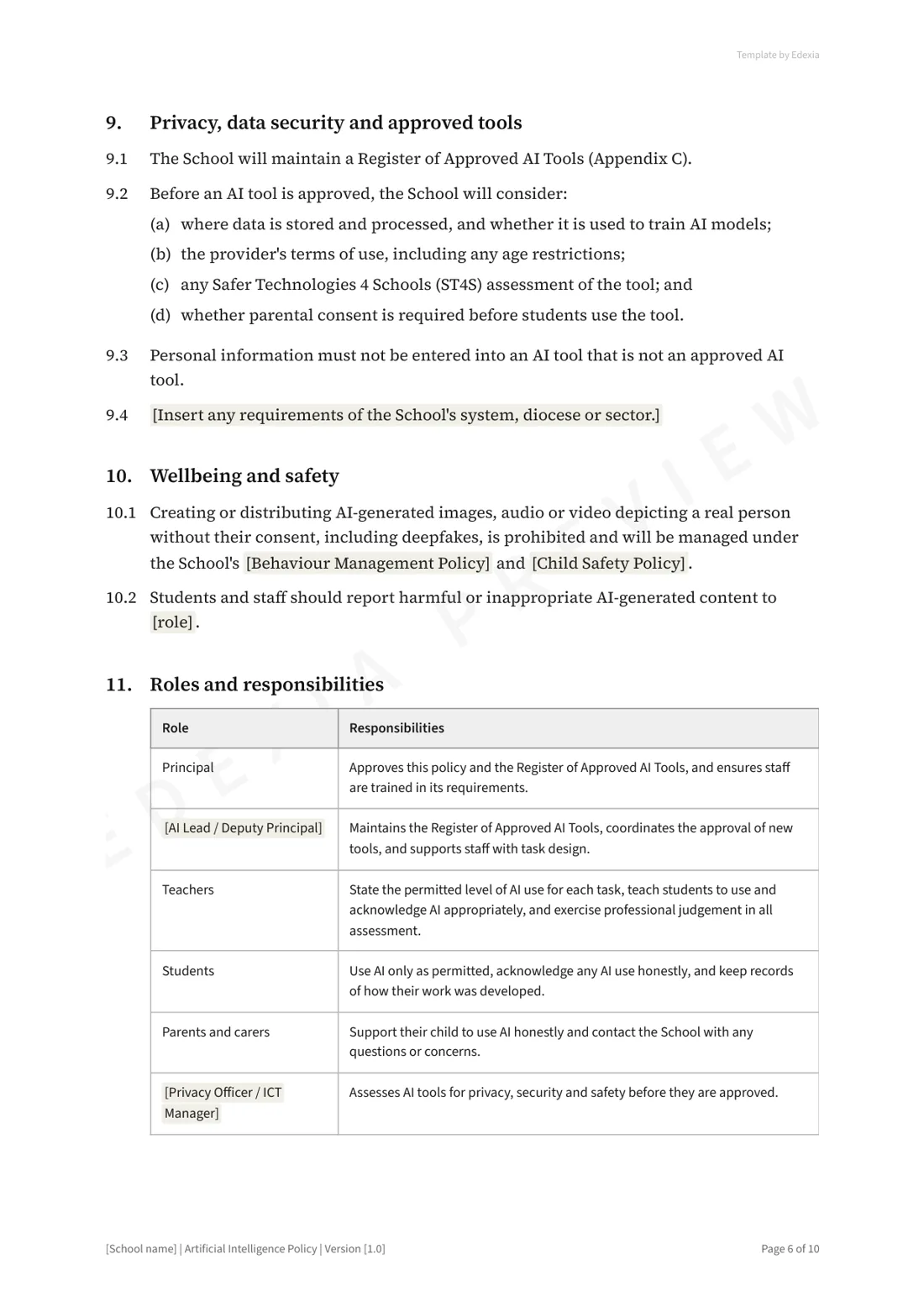
The school keeps a register of approved AI tools, checked for where data is stored, age limits, consent and any Safer Technologies 4 Schools assessment. Personal information only goes into tools on that register, in line with the Office of the Australian Information Commissioner's guidance on public AI chatbots.
Rolling it out
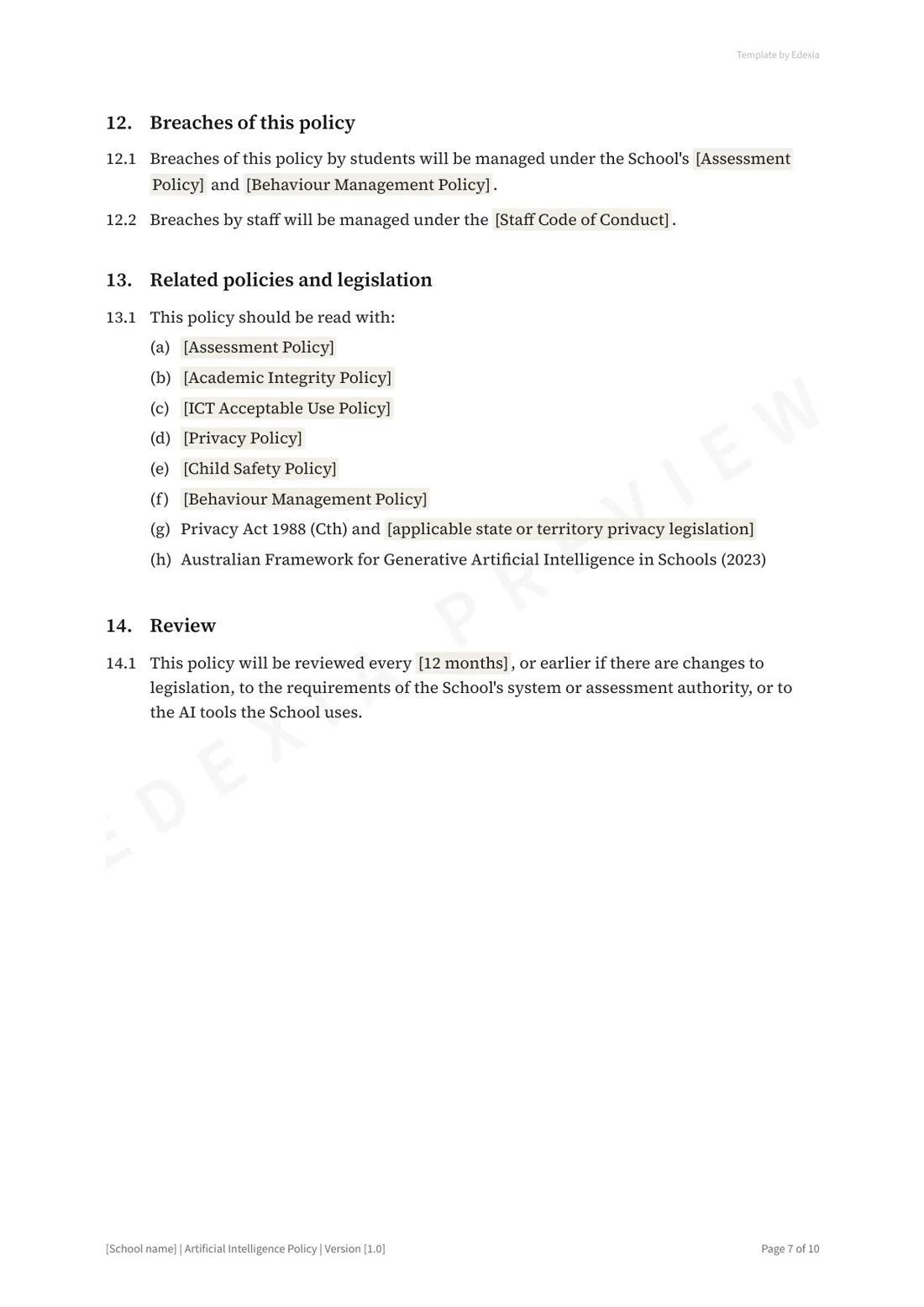
- Complete the fields in square brackets and your system's requirements.
- Ask a few teachers to set an AI level on their next task, and fix what was unclear.
- Talk to students before you publish.
- Send families a short summary of the AI levels.
- Train staff, and review the policy after one term.
Sources: Australian Framework for Generative AI in Schools · OAIC, privacy and commercially available AI products · Safer Technologies 4 Schools. The template is general information, not legal advice. Edexia is independent and is not affiliated with or endorsed by VCAA, NESA, QCAA, SCSA, the SACE Board, TASC, the BSSS, the NT Board of Studies, the IB, College Board or any education department.
Want someone to look over your draft?
We review AI policies for schools at no cost. Send us your draft and we'll talk it through with you.